Driven Skills. Institutional-grade. One prompt away.

Ask a generic AI assistant to "analyze this stock" and you'll get something that sounds like a finance textbook wrote a tweet: confident, readable, and quietly wrong in the places that matter. The model blends valuation methods it doesn't name, leans on whatever it saw most often during training, and happily fabricates a price target with a citation that doesn't exist. For a curious investor, that's a party trick. For anyone with real money on the line, it's a liability.
This is the gap we built the Driven Skills Market to close.
A Skill in Driven is not a prompt template. It's a repeatable, named workflow grounded in a specific investment framework — Markowitz's Modern Portfolio Theory, Jegadeesh-Titman momentum research, Dalio's growth-inflation quadrants, Murphy's intermarket analysis, the classic discounted cash flow. Each Skill defines what questions to ask, which data sources to pull, how to rank and weight evidence, and how to present the result. Your agent runs any one of them on demand. You stay in the chat; the Skill handles the discipline.
Today we're launching the first batch of built-in Skills, spanning the full investor workflow: Research, Macro, Sectors, Screening, Single Stock, Smart Money, and Portfolio. The Market will keep growing from here.
Sitting under every Skill is Driven's data foundation: 230+ professional investment APIs covering global market data, financials, exchange filings, analyst consensus, ownership disclosures, macro series, and alternative data. A framework is only as good as the data under it — so we plumbed this layer directly into professional feeds rather than scraping public sources.
One more design choice worth surfacing: every number in a Skill output — financials, prices, valuation inputs, factor scores, positions — comes straight from these data APIs, not from the model. The LLM orchestrates the workflow and narrates the findings; it doesn't invent the numbers. So when you see a figure in a Driven output, its source is traceable — not a confident-looking citation that falls apart the moment you check it.
This post walks through the design principles behind the built-ins.
The design principles behind every Skill
1. Grounded in named frameworks, not vibes
Every built-in Skill in the Market is anchored in a specific, citable methodology. Not "best practices" in the abstract — actual frameworks from the academic and institutional finance canon.
- Sector Radar weights momentum using Jegadeesh & Titman (1993), and deliberately skips 1-month momentum — the short-term reversal literature (Jegadeesh 1990 onward) shows that at short horizons the reversal effect overwhelms the momentum signal.
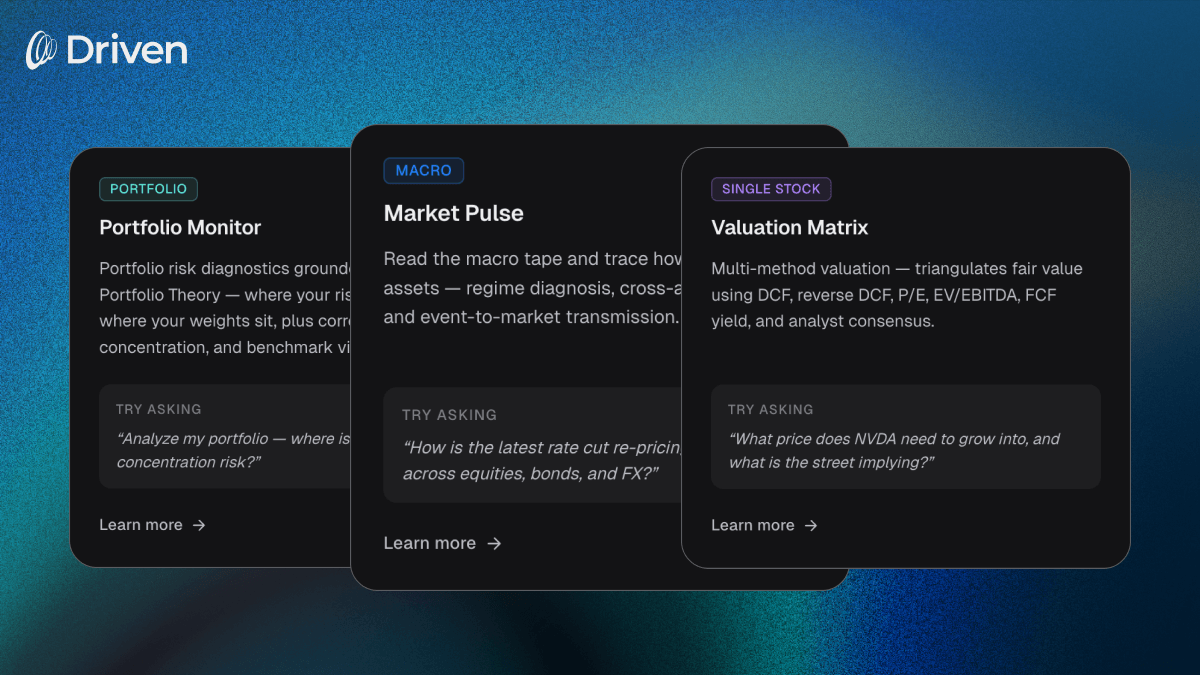
- Portfolio Monitor decomposes risk using Markowitz (1952) covariance math — the insight that a 50% position can contribute 66% of total portfolio risk if it moves together with the rest of the book.
- Market Pulse places the macro environment in one of four Dalio growth-inflation regimes, traces event transmission through the five IMF/BIS channels (interest rate, credit, asset price, exchange rate, expectations), and uses Murphy's intermarket rule: when cross-asset signals conflict with the tape, the cross-asset read wins.
- Stock Analysis scores business health with the Altman Z-Score for bankruptcy risk and the Piotroski F-Score for value-quality.
- Valuation Matrix triangulates across DCF, forward P/E, EV/EBITDA, FCF Yield, and analyst consensus — with a reverse DCF that solves backward from today's market cap for the implied FCF growth rate, so you see both fair value and market expectations in the same pass.
Naming the framework matters for two reasons. First, it's honest: an answer is only as good as the method behind it, and the method deserves to be visible. Second, it's auditable: when a Skill output surprises you, you can trace the logic to a published reference and decide for yourself whether the approach applies.
2. Peer-relative scoring, not absolute thresholds
A 15% gross margin is weak in enterprise software and elite in grocery. A P/E of 25 is cheap for a high-growth compounder and expensive for a utility. Absolute thresholds — the kind a generic assistant defaults to — generate false positives the moment you cross a sector boundary.
Driven's scoring Skills rank inside the peer set:
- Stock Screener scores Valuation as a percentile against the other screened names, not against a hardcoded P/E cut-off. Missing dimensions (banks without meaningful EV/EBITDA, for instance) get a neutral score and the weight redistributes.
- Competitor Analysis ranks every peer on Revenue Growth (30%), Profitability (25%), Efficiency (20%), Margin Momentum (15%), and R&D (10%), with R&D weight redistributing when the peer set doesn't compete through R&D (consumer staples, utilities).
- Sector Radar ranks PE inside the scanned ETF set — comparing tech against tech, staples against staples.
The net effect: you get a verdict that's meaningful within its comparison, not a number that happens to look elite until you remember what industry you're in.
3. Multi-source verification, not single-source retrieval
The cost of an AI getting a fact wrong is not the fact — it's the confidence with which the fact is wrapped. Deep Research is built around that asymmetry.
When you ask for a deep dive, the Skill fans out across web search (neural for broad queries, keyword for precise ticker matches), SEC filings, earnings call transcripts, analyst articles, and structured financial data — all in parallel. Then it does something most AI workflows skip: it cross-verifies. Claims that land from only one source are flagged as unverified. Facts (earnings numbers, price data) are separated from opinions (ratings, commentary). Stale items are flagged by date. The output is an analyst-style brief with citations, delivered as a downloadable file so the chat stays clean and the full analysis is reviewable later.
The design lesson: breadth beats any single best source. If an AI tells you NVDA's data-center revenue grew 112% last quarter, you want to know whether that showed up in the 10-Q, the earnings press release, and the transcript — or whether it came from one article that might have been wrong.
4. Adaptive depth, matching how analysts actually work
A professional doesn't run the same playbook for "why did TSLA drop 8% yesterday" and "is META reasonably valued at today's price." The first needs sentiment and technicals in under a minute. The second needs fundamentals, valuation, technicals, and sentiment, triangulated.
Stock Analysis and Valuation Matrix scale without a mode switch. Depth follows the prompt. Ask a focused question, get a focused answer. Ask for a full analysis, get all four dimensions with cross-checks. This is how senior analysts actually spend their time — not running the same report every morning, but pulling the right lens for the question in front of them.
5. Conviction filters, not raw signals
Insider Tracker follows four streams of smart-money disclosure — Form 4 insider trades, 13F institutional holdings, US congressional trades under the STOCK Act, and major shareholder changes. But the Skill doesn't stop at "insider X sold $5M." It filters:
- Cluster buying (multiple insiders in the same name, same window) weighs more than a single trade.
- C-suite vs director splits — CEO and CFO purchases carry more weight than director trades.
- Size relative to existing holdings — a $5M buy from someone holding $10M is meaningful; the same size from someone holding $500M is noise.
- Pre-set 10b5-1 plans, tax-driven selling, diversification are deliberately deprioritized, because insider selling alone is rarely bearish.
- 13F is 45 days delayed — the Skill surfaces that so you know the position shown is already stale.
The difference between a tracker and a signal is everything. Raw disclosure feeds flood you with activity. A well-designed Skill surfaces the conviction.
What a Skill feels like in practice
Here's what changes when you use a Skill instead of a freeform chat:
Before. "Is AMZN cheap right now?" → a generic paragraph comparing P/E to S&P 500 average, a hand-wave about growth, a hedged conclusion.
After. Same question, Valuation Matrix Skill → fair-value ranges across bear / base / bull DCF scenarios, P/E vs sector range, EV/EBITDA on a capital-structure-neutral basis, FCF yield benchmarked to the sector, analyst consensus as a cross-check, and the FCF growth rate today's price already implies. What you get is the spread between fair value and current price, and the gap between market-implied growth and analyst expectations — the call stays with you.
Same question. Different answer shape. Different decision quality.
Made by investors, for investors
Driven is built by a team that spends its own money in these markets. The design bias comes from a simple premise: serious investing deserves serious tools, and AI has been too generic for too long in this domain. Every Skill is an answer to a specific investor question we kept asking ourselves — and every design choice is there because the alternative failed us somewhere real.
That's also why these Skills name their methodologies openly. You should know exactly which framework is running, why it's weighted the way it is, and where it falls short. No magic, no black box. Frameworks investors have trusted for decades, executed consistently by your agent.
Try the Skills Market
Every Skill in the Market is available in Driven today — one prompt away. Start with a question you've asked a generic AI recently and watched it fumble. Run the same question through the right Skill. Compare what you get back.
That's the clearest argument we can make.